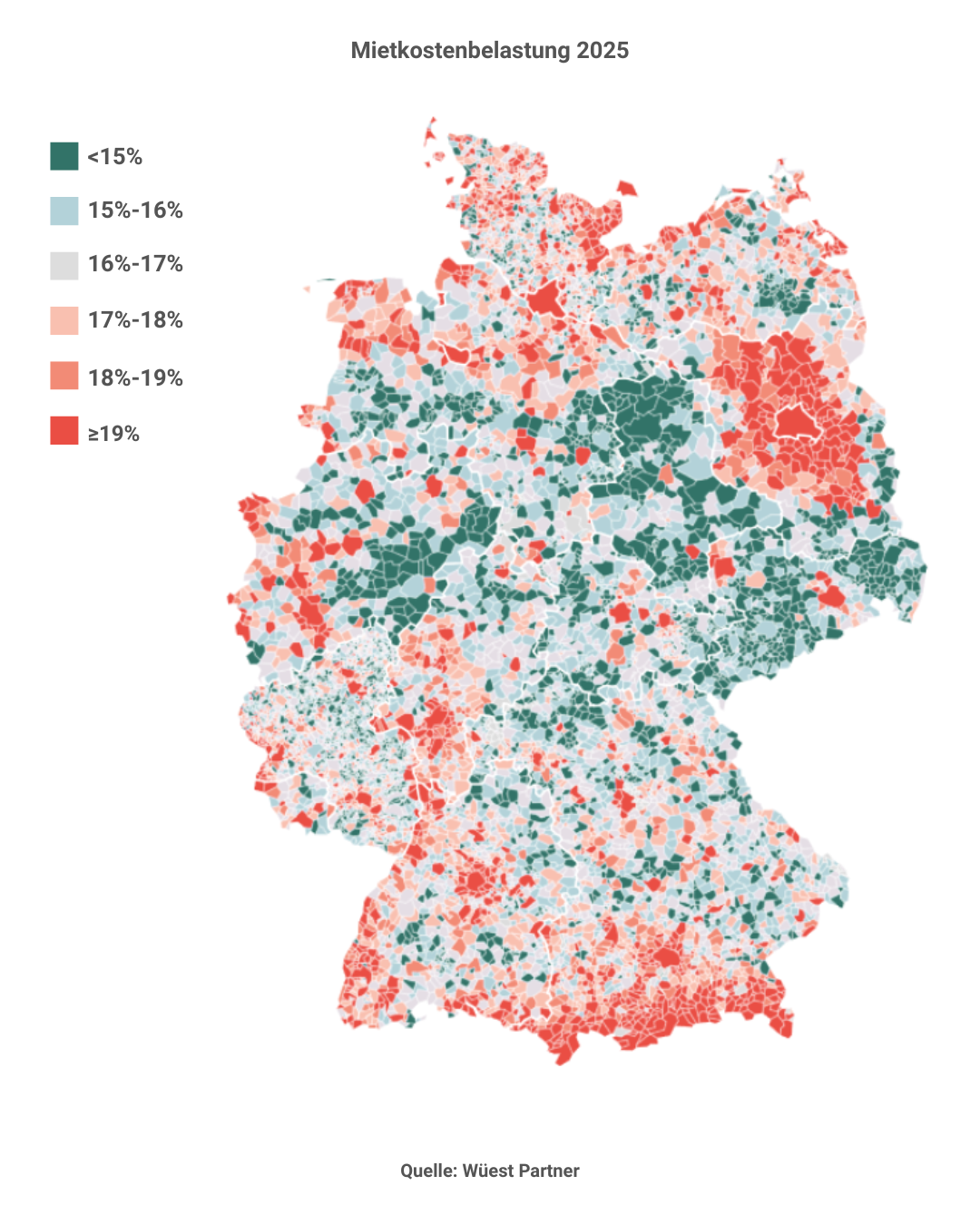
Despite the ongoing challenges in the German housing markets, there are still regions with comparatively low housing costs, particularly outside the major cities. This is the conclusion of a recent analysis by the property consultancy Wüest Partner examining housing cost burdens across all German municipalities. As reported last week by Cash Online, Fonds professionell and Deutsche Finanz Presse Agentur (DFPA), among others, the study shows that housing remains affordable in many regions of Germany. Of particular interest from the perspective of the capital region: whilst Berlin now ranks among Germany’s most expensive housing markets in terms of living costs, numerous surrounding areas continue to offer attractive prospects for tenants, owner-occupiers and investors.
For its analysis, Wüest Partner did not merely examine rental and purchase prices, but also compared actual housing costs with disposable household income. Both rented accommodation and owner-occupied properties were taken into account. A housing cost burden of no more than 30 per cent of disposable income is generally considered affordable.
The results show that rented accommodation remains relatively affordable in many parts of Germany. In most municipalities, tenants spend between 14 and 19 per cent of their disposable income on housing. A housing cost burden of more than 30 per cent remains the exception. The situation is different when it comes to buying a home. Here, housing costs exceed 20 per cent of disposable income in around 90 per cent of all local municipalities, and in roughly one in twenty municipalities it even exceeds the 30 per cent threshold. The main reason for this is the rise in financing costs, which now have a significant impact on the affordability of home ownership.
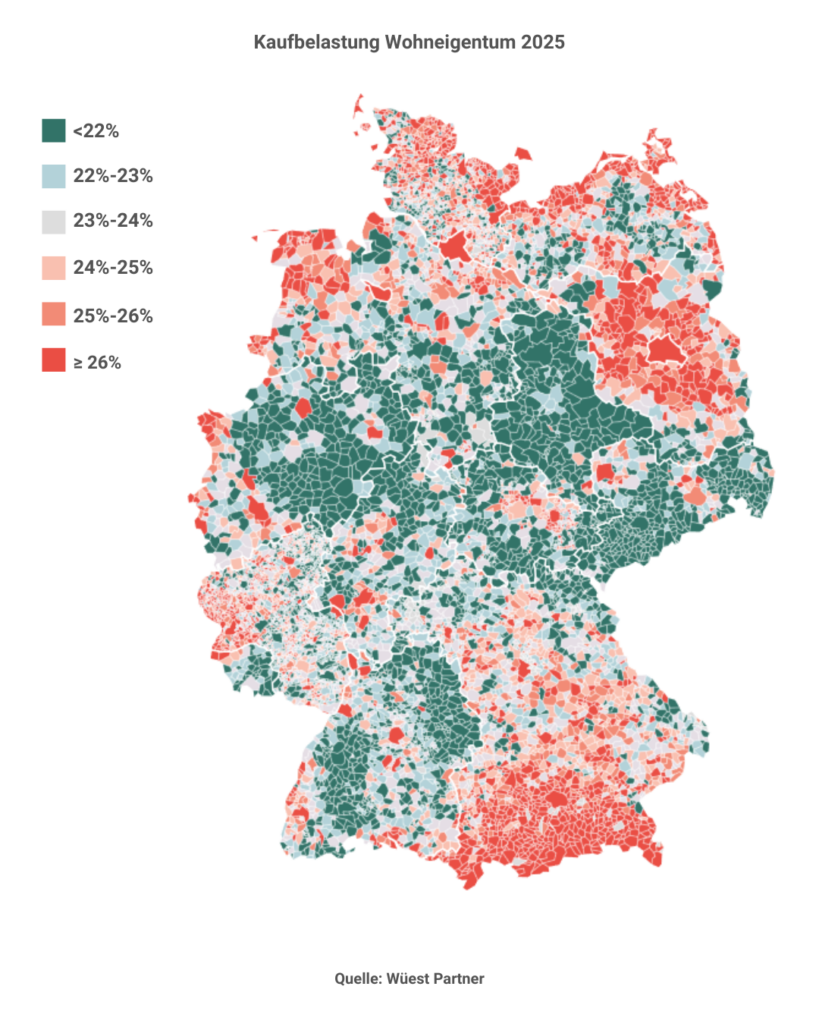
The situation remains particularly tight in Germany’s major cities. In Germany’s seven largest cities, the average rent-to-income ratio already stands at 27.7 per cent of disposable income. Berlin stands out in this regard: with an average rent burden of 30.9 per cent, the capital is the only one of the top seven cities to exceed the widely accepted affordability benchmark of 30 per cent. Berlin is also one of Germany’s most expensive markets for home ownership. The housing cost burden here stands at 35.8 per cent, well above the usual affordability threshold.
At the same time, the analysis confirms a trend that has been evident for several years now: outside the major cities, many regional centres and smaller cities are becoming increasingly attractive places to live. Whilst demand in Berlin remains high and is met by limited supply, numerous towns and villages in the surrounding area continue to offer significantly more affordable housing options. These locations are becoming particularly important for households looking to buy their own home. Furthermore, the upward trend in rents is now spreading more widely to these regions, which further underlines their long-term appeal.
The study also makes it clear that the issue of affordability does not depend solely on property prices. Rather, the decisive factor is the interplay between housing costs, financing costs and income trends. This highlights the growing importance of regional housing markets analysis. Wüest Partner concludes that expanding the housing supply remains the most important lever for keeping housing affordable in the long term.
“The results show once again just how widely housing markets across Germany have diverged. Whilst housing costs in Berlin have now reached a very high level, the areas surrounding Berlin continue to offer attractive opportunities for owner-occupiers and investors. It will be crucial to significantly expand the housing supply in both the capital and the surrounding regions. This is the only way to ensure the long-term affordability of housing,” says Jacopo Mingazzini, CEO of The Grounds.