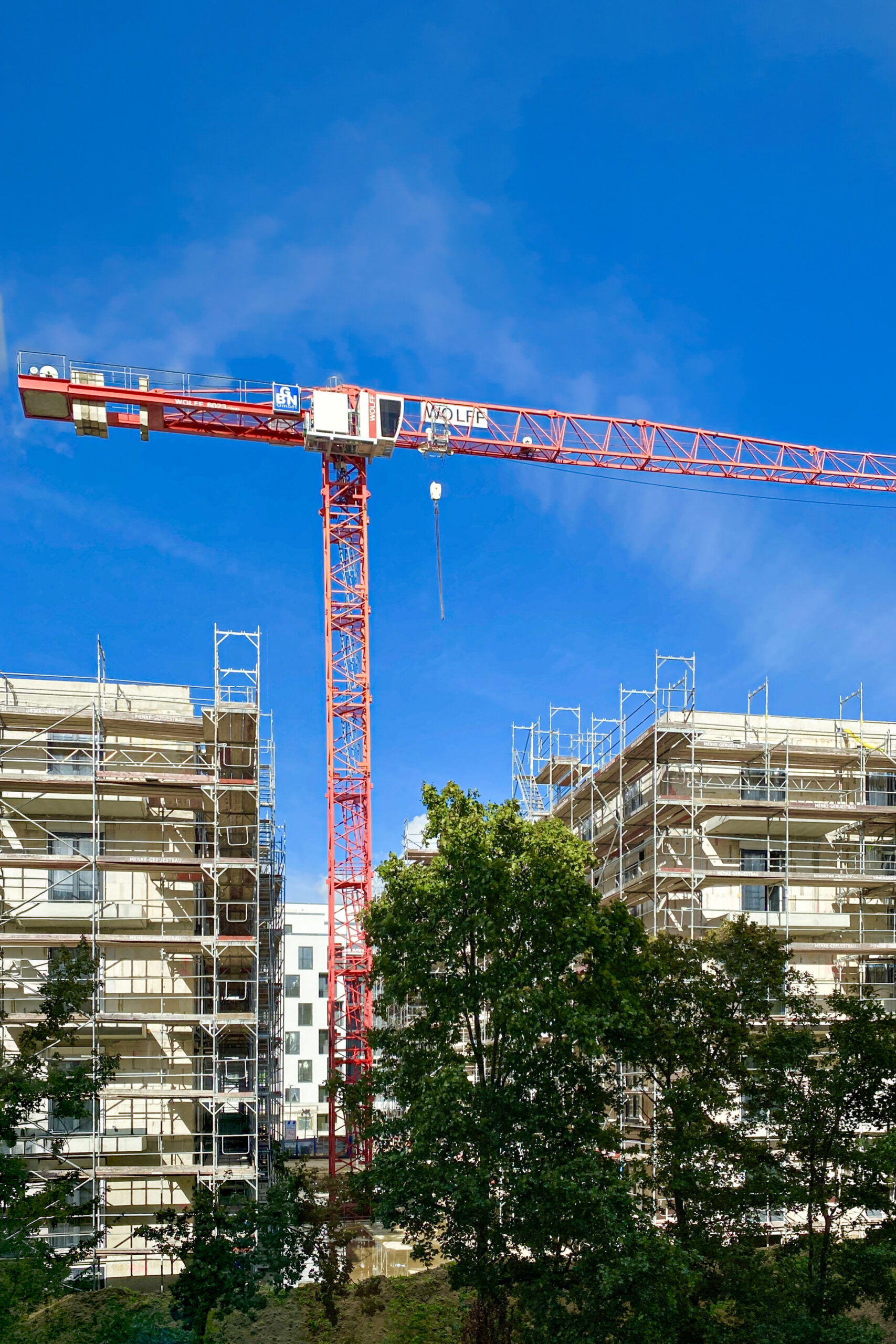
Although Germany is currently short of around one million homes, only 206,600 residential units were completed in 2025, according to the Federal Statistical Office. This represents a decline of around 45,000 units compared with the previous year and marks the lowest level since 2012. The shortage of housing continues to drive up rents, particularly in cities and metropolitan areas. In Berlin, housing and rental costs are therefore among the key issues ahead of the state election in September 2026. High construction costs, which have risen further due to the Iran war and higher interest rates, are one of the main reasons why too few homes are being built in Germany.
At an investor conference in Frankfurt am Main at the end of June, Federal Minister for Housing, Urban Development and Building Verena Hubertz and Federal Finance Minister Lars Klingbeil presented an action plan aimed at reducing construction costs and stimulating residential development. The plan was reported by, among others, Handelsblatt and Die Welt. Published by the Federal Ministry for Housing, Urban Development and Building (BMWSB), the Action Plan to Reduce Construction Costs comprises 13 measures and focuses on three key levers: digitalisation to accelerate planning approval and construction processes, improved investment and funding conditions, and the simplification of building standards.
Specifically, the action plan provides that planning applications will in future only be submitted digitally. From 2028 onwards, paper applications will only be accepted in justified cases of hardship. From 2027, support for new residential construction is to be consolidated into a single modular funding programme designed to create targeted incentives for cost and space efficient building. A particular focus is on helping families finance home ownership. In addition, local development planning procedures are to be accelerated through standardised data models and limited to a maximum of two years. To speed up construction, the BMWSB also proposes a bonus system rewarding shorter construction periods achieved through serial and modular construction methods. Furthermore, the introduction of Building Type E is intended to make it easier to deviate from technical standards and regulations while maintaining legal certainty.
The action plan describes residential construction as a task of national importance that cannot be addressed by the federal government alone, but only through a joint effort involving the federal government, the federal states, municipalities and the private sector. To mobilise private capital for residential development, the BMWSB plans to establish a dedicated housing module within the Germany Fund. This is intended to attract investors seeking a combination of high security and moderate returns. In a press release accompanying the presentation of the action plan, Federal Housing Minister Verena Hubertz said that the German housing market offers attractive long term prospects for sustainable and profitable investment.
“The Federal Ministry for Housing has addressed a number of key demands put forward by the real estate and construction industries in its action plan, including digital planning approval procedures, simpler building standards and a more streamlined funding framework. However, the plan currently remains no more than a catalogue of proposed measures. Federal Housing Minister Verena Hubertz must now move quickly to present the corresponding draft legislation,” says Jacopo Mingazzini, Member of the Management Board of The Grounds. “It is also encouraging to see the clear acknowledgement that the public and private sectors must work together to increase housing construction. The real estate and construction industries are ready to play their part. It is now up to policymakers to implement the announced measures without delay.”